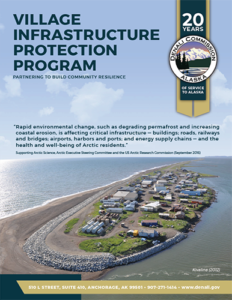
In 2015 the White House directed the Commission to establish a Village Infrastructure Protection (VIP) Program to assist rural Alaskan communities that are threatened by erosion, flooding and permafrost degradation. The goal of the VIP Program is to mitigate the impact of these threats with respect to safety, health and the protection of infrastructure.
The basis for the program is Government Accountability Office (GAO) Report 09-551 that was published in 2009. The report identified 31 rural Alaska communities that face significant damage to infrastructure, and/or relocation due to these threats. The State of Alaska has also done significant research on this problem through an Immediate Action Workgroup established by Governor Sarah Palin in 2007.
One of the villages imminently threatened is Newtok, where permafrost degradation acting in combination with Ninglick River currents has resulted in a river bank erosion rate of 70 feet per year. Numerous homes, the school and the airport will be destroyed within the next 2 to 4 years. Relocating the community to safer ground is the only alternative.
The Commission has received no new recurring appropriations for the VIP Program. However, in fiscal years 2016 through 2020 the agency invested a total of just under $40 million of its discretionary program funds for VIP related initiatives; primarily in support of the four most vulnerable communities identified in GAO Report 09-551 (Newtok, Kivalina, Shaktoolik, and Shishmaref). Our primary program partners are the Alaska Native Tribal Health Consortium who is providing overall project management services for the Newtok Relocation Project, the U.S. Army Corps of Engineers and University of Alaska – Fairbanks who developed the Statewide Threat Assessment, and several agencies within the State of Alaska such as the Alaska Energy Authority and the Division of Community and Regional Affairs.
In partnership with ANTHC, the Commission also established the Center for Environmentally Threatened Communities (CETC), which supports rural Alaska communities experiencing infrastructure impacts resulting from flooding, erosion, and melting permafrost. Since 2017, CETC staff have worked with 22 communities to address environmental threats and achieve their vision of a safe, healthy, and sustainable future. Their two areas of focus are:
- Securing funding by working closely with communities so they can replace damaged community infrastructure, move homes and community buildings, develop new subdivisions, gain a better understanding of risk, and advance long-term planning.
- Helping to build community capacity to respond to threats by providing grant training and technical assistance.
Statewide Threat Assessment 2026:
The Denali Commission, in partnership with the U.S. Geological Survey, Army Corps of Engineers, and contractor AECOM, is updating Alaska’s Statewide Threat Assessment, originally completed in 2019.
The 2019 assessment identified Alaska communities most at risk from natural hazards and provided vulnerability ratings for permafrost degradation, flooding, and erosion across more than 180 communities statewide. These ratings helped inform infrastructure planning, resilience investments, and coordinated federal and state responses to emerging environmental threats.
What This Update Will Do
The updated assessment will:
- Reevaluate the same communities included in the 2019 assessment
- Incorporate new data and observed changes in community vulnerability
- Expand the hazards evaluated to include:
- Earthquake
- Volcano
- Landslide
- Tsunami
- Wildfire
- Continue evaluating permafrost degradation, flooding, and erosion
The goal of this update is to provide decision-makers, communities, and partner agencies with current information to support infrastructure planning, hazard mitigation, and resilience efforts across Alaska.
Community Outreach
Public engagement is an important part of this effort. The project team recently held a series of outreach meetings to share information about the assessment update and to identify additional local knowledge and unpublished data sources that could improve the analysis. These were held Jan 27 – Bethel | Feb 2 – Anchorage (Dena’ina Center) | Feb 6 – Anchorage (Atwood Bldg) | Feb 10 – Juneau | Feb 26 – Fairbanks
Learn More and Participate
We encourage community members, organizations, and agencies to explore the resources below and share relevant information that may improve the assessment. Additional public meetings will be posted to circulate the draft report and collect feedback at that time.
Project Resources
📄Project Presentation
Download the slideshow used during the outreach meetings.
❓Frequently Asked Questions
Learn more about the purpose of the assessment, how communities are evaluated, and how the results may be used.
- Is my community part of the Statewide Threat Assessment Update?
- The Statewide Threat Assessment Update focuses on remote communities with limited data and resources, similar to the approach used in the 2019 Statewide Threat Assessment. Alaska’s larger, urban communities are not included. To find out if your community is being reassessed, please refer to the appendices of the 2019 report, which list all included communities.
- Who is being targeted for outreach in small communities—tribes, local governments, or others?
- The project team is engaging tribes, local governments, village and regional corporations, other regional organizations, and other local leaders who possess valuable community knowledge. Questionnaires and outreach materials are being distributed to these groups, and follow-up phone calls are made to ensure broad participation. We welcome participation from any interested member of the community.
- Are the questionnaires or outreach materials available in languages other than English?
- Currently, questionnaires and outreach materials are only available in English. We recognize the importance of language accessibility and welcome feedback on translation needs.
- How were the hazards of earthquake, landslide, tsunami, volcano, and wildfire selected for inclusion?
- The project aimed to identify the top 10 threats and hazards to Alaska’s communities and critical infrastructure. The selection process began with the State of Alaska Hazard Mitigation Plan, which served as the primary reference for determining which hazards to include. Additionally, drought and glacial lake outburst flooding were initially considered, but were ultimately excluded due to a lack of sufficient, analysis-ready data at the time of the literature review. Drought data are included in the wildfire hazard.
- Does this project address anthropomorphic (human-caused) factors such as environmental impacts from industry-related activities?
- No, this project focuses specifically on environmental threats that arise from natural processes, such as flooding, erosion, permafrost thaw, and other climate-related hazards.
- How will the final report or findings be communicated back to communities, and will it be translated?
- The draft report will be posted for a limited time on the Denali Commission website for public review. In addition, the project team will share key findings during up to four community meetings. All findings and reports will be provided in English. Once finalized, the full report will be available on the Denali Commission website.
- How is climate change being addressed?
- The Statewide Threat Assessment Update now includes a new evaluation criterion called “Changing Conditions” to specifically consider the impacts of climate change. The primary data source for this criterion is the Northern Climate Reports, which are developed by the Scenarios Network for Alaska + Arctic Planning at the International Arctic Research Center, University of Alaska Fairbanks. These reports provide current and regionally relevant climate information to support the assessment.
- Will the Statewide Threat Assessment Update provide recommendations on community relocation?
- No, the Statewide Threat Assessment Update will not provide recommendations on community relocation. The project’s focus is on identifying and assessing environmental threats.
- What is being done to address data gaps or high-uncertainty communities?
- The project team is addressing data gaps by conducting community outreach to gather local insights and information. For each hazard in every community, the assessment will document the level of data uncertainty, following the approach used in the 2019 Statewide Threat Assessment. This process ensures that both the availability and quality of data are recorded, making it clear where more information or future research may be needed.
- Will the Statewide Threat Assessment Update occur again?
- The Statewide Threat Assessment is expected to be updated approximately every five years.
📝Community Questionnaire
Share local knowledge, observations, or data sources that may help improve the hazard analysis. Handout available here. Responses are requested no later than April 10, 2026.
📊Evaluation Criteria
Download the criteria used to assess community vulnerability to natural hazards.
Upcoming Public Meetings
Additional public meetings will be scheduled this fall to share the draft report and collect community feedback. Details and locations will be posted here as they become available.
Contacts:
Main Office – (907) 271-1414
Joshua Wilson – Village Infrastructure Protection Program Manager – (907)-342-9842 – jwilson@denali.gov
Key Publications
- VIP Program Fact Sheet (March 2019)
- VIP Program Fact Sheet (August 2017)
- GAO Report 04-142
- GAO Report 09-551
- Alaska Baseline Erosion Assessment
- IAWG Recommendations to the Governor’s Subcabinet on Climate Change
- The United States National Climate Assessment – Alaska Technical Regional Report
- A Guide To Community Resilience
- Catalog of Federal Resilience Programs for Alaskan Communities
- Final Environmental Impact Statement – Mertarvik Infrastructure Development
- Statewide Threat Assessment
- A Phased Approach to Village Relocation: Guidance for incremental, community-driven village relocation
Key Links
- DCRA Resilience, Planning, and Land Management
- Alaska Department of Military and Veterans Affairs (DHS&EM)
- Alaska Department of Natural Resources (DGGS)
- Alaska Center for Climate Assessment and Policy
- US Department of Commerce – NOAA Office For Coastal Management
- US Department of Homeland Security – Federal Emergency Management Agency
- US Department of Interior – Bureau of Indian Affairs Tribal Resilience Program
- US Department of Interior – Fish & Wildlife Service Landscape Conservation Cooperatives
- US Arctic Research Commission
- Community Risk Assessment and Resilience Planning Partnership
- Community Resilience Resources, Division of Community and Regional Affairs
- Communities Most Threatened by Natural Hazards
- US Department of Interior – Fish & Wildlife Service Landscape Conservation Cooperatives See Also:https://www.frames.gov/catalog/17516
Featured Project
Relocation of Newtok to Mertarvik


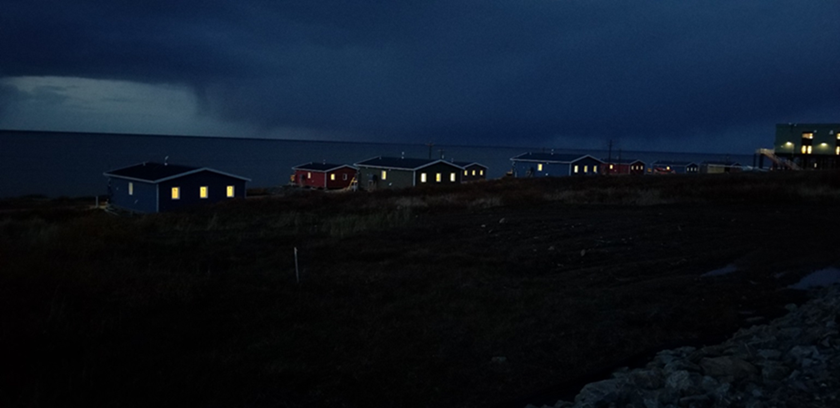
The Commission is working with numerous local, state and other federal agencies in a combined effort to relocate the village of Newtok to a new site called Mertarvik. To date, the Commission has provided more than $27 million for the project. For more information on the relocation of Newtok to Mertarvik please see the Final Environmental Impact Statement referenced above, the Mertarvik Project Fact Sheet, and the Newtok Planning Group website.